
Bogor (Indonesian: Kota Bogor) is a city on the island of Java in the West Java province of Indonesia. The city is located in the center of the Bogor Regency (Indonesian: Kabupaten Bogor), 60 kilometers south of the Indonesian capital Jakarta.
Bogor itself is a recognized as a municipality (cat); it is an important economic, scientific, cultural and tourist center, as well as a mountain resort. In the Middle Ages, the city was the capital of Sunda Kingdom (Indonesian: Kerajaan Sunda) and was called Pakuan Pajajaran. During the Dutch colonization of Indonesia, it was named Buitenzorg and served as the summer residence of the Governor-General of Dutch East Indies. The city was the administrative center of the Netherlands East Indies during the British control in the early 19th century. With several hundred thousand people living on an area of about 20 km², the central part of Bogor is one of the world’s most densely populated areas. The city has a presidential palace and a botanical garden (Indonesian: Kebun Raya Bogor) – one of the oldest and largest in the world. It bears the nickname “the Rain City” (Kota Hujan), because of frequent rain showers. It nearly always rains even during the dry season.
Bogor itself is a recognized as a municipality (cat); it is an important economic, scientific, cultural and tourist center, as well as a mountain resort. In the Middle Ages, the city was the capital of Sunda Kingdom (Indonesian: Kerajaan Sunda) and was called Pakuan Pajajaran. During the Dutch colonization of Indonesia, it was named Buitenzorg and served as the summer residence of the Governor-General of Dutch East Indies. The city was the administrative center of the Netherlands East Indies during the British control in the early 19th century. With several hundred thousand people living on an area of about 20 km², the central part of Bogor is one of the world’s most densely populated areas. The city has a presidential palace and a botanical garden (Indonesian: Kebun Raya Bogor) – one of the oldest and largest in the world. It bears the nickname “the Rain City” (Kota Hujan), because of frequent rain showers. It nearly always rains even during the dry season.

The city is situated in the western part of Java island, about 60 km south of the capital Jakarta and 85 km northwest of Bandung, the administrative center of West Java Province.Bogor spreads over a basin near volcanoes Salak, which peaks at about 12 km south, and Gunung Gede whose top is 22–25 km south-east of the city.[36] The average elevation is 265 meters, maximum 330 m, and minimum 190 meters above sea level.[1] The terrain is rather uneven: 17.64 km² of its area has slopes of 0–2°, 80.9 km² from 2° to 15°, 11 km² between 15° and 25°, 7.65 km² from 25° to 40° and 1.20 km² over 40°;[37] the northern part is relatively flat and the southern part is more hilly
The soils are dominated by volcanic sedimentary rocks.[38] Given the proximity of large active volcanoes, the area is considered highly seismic.[36] The total area of green space is 205,000 m², of which 87,000 m² are Bogor Botanical Gardens, 19,400 m² are taken by 35 parks, 17,200 m² by 24 groves and 81,400 m² are covered with grass.
Several rivers flow through the city toward the Java Sea. The largest ones, Ciliwung and Cisadane, flank the historic city center. Smaller rivers, Cipakancilan, Cidepit, Ciparigi and Cibalok, are guided by cement tubes in many places.[36] It is worth noting that “ci” in the river names mere means “river” in Sundanese, and the actual name begins after it, but the “ci” is nevertheless included into national and international maps. There are several small lakes within the city, including Situ Burung (lit. Bird Lake; “Situ” meaning “Lake”) and Situ Gede (lit. Great Lake), with the area of several hectares each. Rivers and lakes occupy 2.89% of the city area.
The climate is equatorial, and more humid and rainy than in many other areas of West Java – the average relative humidity is 70%,the average annual precipitation is about 1700 mm, but more than 3500 mm in some areas. Most rains fall between December and February.Because of this weather, Bogor has the nickname “Rain City” (Indonesian: Kota hujan). The temperatures are lower than in Java: the average maximum is 25.9 °C (cf. 32.2 °C in Jakarta). Daily fluctuations (9–10 °C) are rather high for Indonesia. The absolute maximum temperature was recorded at 38 °C and the minimum at 3 °C
Administration
 Coat of arms of Bogor
Bogor City belongs to the Bogor Regency (kabupaten) and in itself is a separate municipality (cat).[12][60] The city is divided into six areas (kecamatan), which contain 68 low-level administrative units, 31 of which have the status of settlement and 37 are villages.
| English name | Original name | Area in km² | Population | Number of settlements and villages |
|---|---|---|---|---|
| North Bogor | Kecamatan Bogor Utara | 17.72 | 170,320 | 8 |
| South Bogor | Kecamatan Bogor Selatan | 30.81 | 180,745 | 16 |
| East Bogor | Kecamatan Bogor Timur | 10.15 | 94,572 | 6 |
| West Bogor | Kecamatan Bogor Barat | 32.85 | 210,450 | 16 |
| Central Bogor | Kecamatan Bogor Tengah | 8.13 | 102,203 | 11 |
| Tanah Sareal | Kecamatan Tanah Sareal | 18.84 | 190,776 | 11 |
The city is headed by the mayor elected by the citizens every 5 years, together with vice-mayor; in the past, the mayor was appointed by the provincial administration. Diani Budiarto became the first elected mayor of Bogor on 25 October 2008 and assumed his position on 7 April 2009.Legislative power is provided by the City Council which consists of 45 people’s representatives who are also elected by the residents for a 5 year term. Nine political parties consisting of five fractions are represented in the Council.
The coat of arms of Bogor is a rectangular heraldic shield with a pointed base and the side lengths ratio of 5:4, divided by a cross into four parts. The upper left quarter contains the State Emblem of Indonesia – the mythical bird Garuda, in the upper left is the presidential palace, in the bottom left is the Salak volcano, and in the lower right is the national Sundanese dagger kujang. The inscription on top reads “KOTA BOGOR” meaning “CITY BOGOR”
Transport
Bogor is a major transport center of Java. It contains 599.2 kilometers of roads (as of 2008) which cover 5.31% of the city area; 30.2 kilometers of the roads are of national and 26.8 km of prefectural importance.[80] The 22 transport lines are operated by 3,506 buses and minibuses. In addition, 10 bus routes connect the city with the nearest metropolitan area (4,612 buses) and 40 with other cities of West Java (330 buses).[81] There are two major bus terminals, Baranangsiang and Bubulak. The former has an area of 22,100 m² and is dedicated to long-distance and freight traffic while the latter (area 11,850 m²) serves urban passenger routes.[82] A separate station is dedicated to tourist coaches and buses to the nearest Soekarno–Hatta International Airport in Jakarta, located about 55 kilometers from Bogor.[82] Recent years see a significant increase in the number of traditional Indonesian rickshaw (becak) at more than 2,000 units as of 2009.[83] The train station of Bogor was built in 1881, and currently serves about 50,000 passengers and has about 70 departures and 70 arrivals per day.
Health
The first hospitals were established in Bogor in the first half of the 19th century by the Dutch authorities. By the early 20th century, there were several civilian hospitals, a military hospital, and a large psychiatric hospital with doctors from Europe and North America. In the 1930s, the Dutch Red Cross Society hospital became the largest in the city. Most of the existing hospitals and clinics are built in the 1980s–1990s. They include 11 hospitals, 373 private clinics, 51 single-doctor clinics and 134 pharmacies and drug stores, and employ 274 general practitioners, 122 dentists, 74 sanitation doctors, 37 radiologists (X-ray), 141 gynecologists, 32 nutritionists, 55 assistants, 710 nurses, 63 pharmacists and 99 doctors of other specialties.
The 11 hospitals of Bogor are:
- Hospital of the Indonesian Red Cross Society (Indonesian: Rumah Sakit Palang Merah Indonesia) – general, the oldest in the city
- “Karya Bhakti” (Indonesian: Rumah Sakit Karya Bhakti) – general
- “Salak” (Indonesian: Rumah Sakit Salak) – general
- “Ciawi” (Indonesian: Rumah Sakit Ciawi) – hospital of the Indonesian Red Cross Society, general
- “Atang Sanjaya” (Indonesian: Atang Sanjaya) – general hospital of Air Force
- Bogor Medical Center – general practitioners, private
- Islamic Hospital (Indonesian: Rumah Sakit Islam) – general, only for Muslims
- “Azra” (Indonesian: Rumah Sakit Azra) – women and children
- “Melania” (Indonesian: Rumah Sakit Melania) – women and children
- “Hermina” (Indonesian: Rumah Sakit Hermina) – women and children
- “Marzuki Mahdi” (Indonesian: Rumah Sakit Marzuki Mahdi) – infectious diseases
Media
Bogor has two daily Indonesian-language newspapers[115] – “Radar Bogor”, founded in 1998 and Jurnal Bogor, founded in 2008. Both print in about 25,000 copies and have electronic versions. Bogor offices also partly print part some Javanese and national newspapers. There are a few magazines and scientific publications of the local universities.
The two municipal TV channels, “Bogor-TV” and “Megasvara TV” broadcast at UHF channel 25 over the city and nearby areas of West Java. There are also at least 30 local radio stations, of which 20 are in the FM and 10 in the AM range
Travel and places
 Lily pond in the Bogor Botanical Garden.
On a national tourism exhibition of 2010 in Jakarta, Bogor was recognized as the most attractive tourist city of Indonesia.The city and its surrounding area are visited by about 1.8 million people per year, of whom more than 60,000 are foreigners.[125] The main tourist attraction is the Bogor Botanical Garden. Founded in 1817, it contains more than 6,000 species of tropical plants. Besides, about 42 bird species breed within the garden, although this number is declining and was 62 before 1952. The garden’s 87-hectare area within the city was supplemented in 1866 by a 120-hectare park in suburban town of Cibodas.[127][128][127] The staff of Bogor garden also administer three other major gardens of Iindonesia: the Cibodas Botanical Garden founded 1862 in West Java, the Purwodadi Botanical Garden in East Java and the Eka Karya Botanical Garden founded in 1959 on Bali island. Much of the original rainforest was preserved within the garden providing specimens for scientific studes. Besides, the garden was enriched by collections of palms, bamboos, cacti, orchids and ornamental trees. It became famous in the late 19th century and was visited by naturalists from abroad to conduct scientific research. For example, the Russian St. Petersburg Academy of Sciences had a Buitenzorg scholarship for young scientists to work at Bogor.

The former residence of the Governor-General, now the summer palace of the President of Indonesia
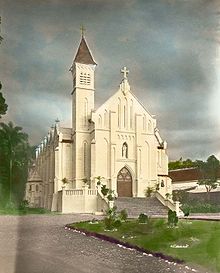
Cathedral. Photo 1920
Another tourist attraction is the presidential palace with the total area of 28 hectares, including 1.8492 hectares of the palace buildings. The palace is surrounded by a park with a small pond.The park is home to a herd of tame deer and is open to the public most of the year. The palace is accessible during holidays, such as the City Day and Independence Day; it has a collection of 450 paintings and 360 sculptures.
The city and its suburbs contain dozens of medieval stone stellas (prasasti). Fifteen prasasti of the greatest historical and cultural value are collected in a special pavilion in the district of Batutulis. In the western part of Bogor there is a large lake Gede (area 6 hectares) surrounded by the reserved forest area and a forest park. In the protected area there are several research facilities, and the recreation areas host sports activities, boating and fishing.
On the territory of the botanic garden, there is a cemetery established in 1784. It contains 42 historical graves of the Dutch colonial officials, military officers and scientists, who served in Bogor, Jakarta and other cities in West Java from the late 18th to early 20th centuries.Nearby, there are three graves of the early Sunda Kingdom (15th century): the wife of the founder of Bogor Silivangi, Galuh Mangku Alam, Ba’ul and commander Japra. The locals regard these individuals as the city’s patrons.Other historical places are the Bogor Cathedral – built in 1750, it is one of the oldest operational Catholic Churches in Indonesia, and the Buddhist temple Hok Tek Bio, built in 1672 in the classical South Chinese style. It is the first Buddhist temple of Bogor and one of the oldest in Indonesia.
Please enjoy visiting bogor :)
Please enjoy visiting bogor :)

0 Response to "Visiting Bogor 2012 | Welcome tourism"
Post a Comment